FARADEX / SECURITY
World-Class Agentic AI.
Zero retention. Zero exposure. Zero compromise.
Agentic AI tools like Cowork and Claude Code get their power by reaching into your local machine: your filesystem, your browser, your desktop. That's how they build context. But for professionals handling sensitive client data in legal, finance, and medical fields, that's a risk you can't take.
Faradex uses a nothing-at-rest architecture. No document store or CDN to breach. No files to steal. No backups to subpoena.
The Faradex Security Boundary
Your documents, conversations, and AI agents all stay inside a boundary your firm controls.
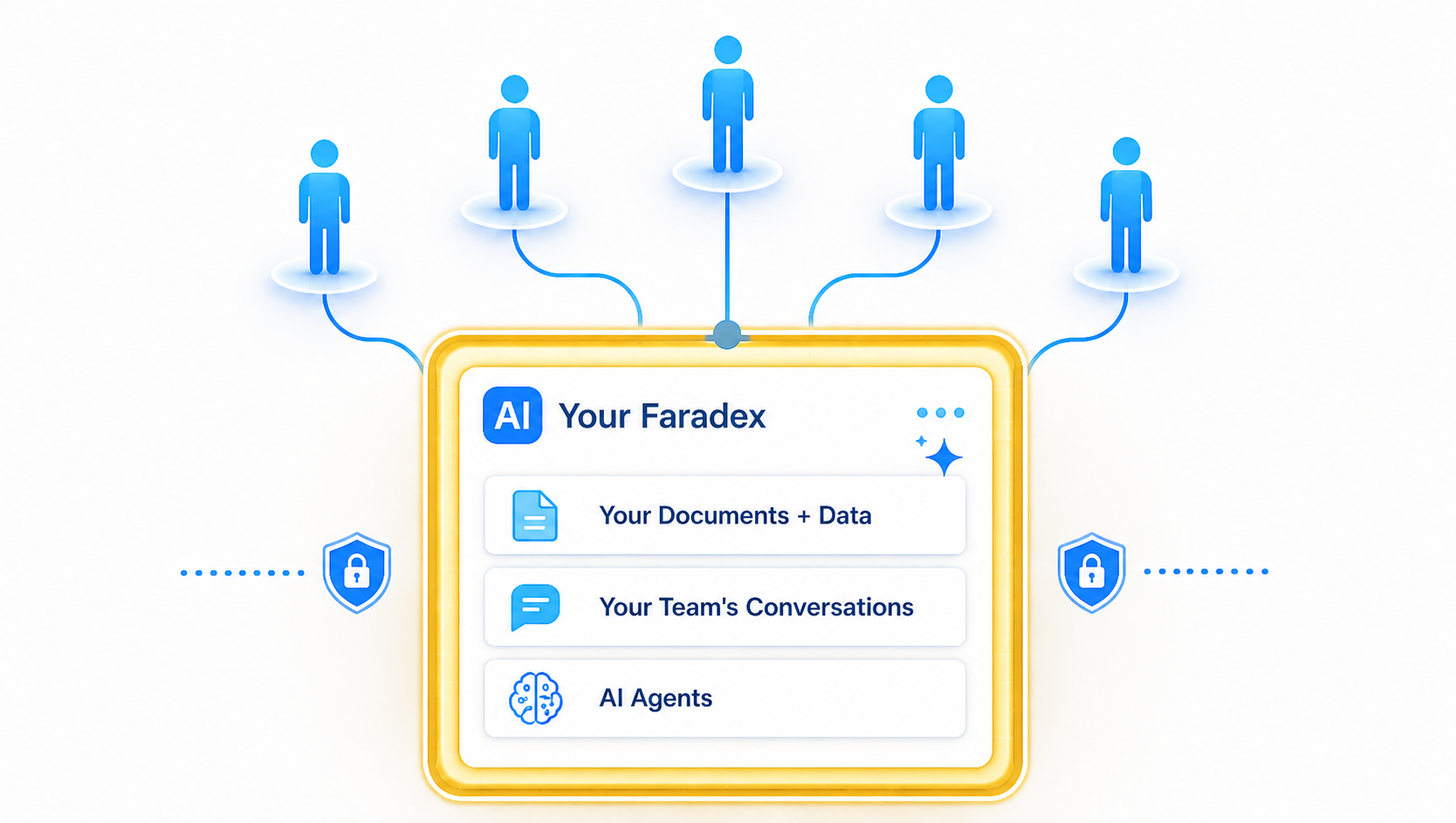
How your data is secured
Security compliance is a complex subject, but how Faradex secures your data can be explained fairly simply:
Your own server, your keys only
Every customer gets a dedicated, single-tenant instance. Your own compute, network, and encryption. No infrastructure is shared with other customers. Only people you invite can get in.
Entirely inside AWS, zero data retention
All AI runs through AWS Bedrock under a zero-data-retention configuration. Nothing is sent to OpenAI, Anthropic, or any other AI service that could store or train on your data.
No logs, no backups, no access
No logs leave your instance. No backups are taken. SSH is disabled on production instances. There is no remote login, no backdoor, and no support tunnel. Even our team cannot see your data.
RAM-only processing
All files exist only in memory, never written to disk. When an instance is deleted, there is nothing for anyone to recover.
Read the article
Why we did this, and what every lawyer needs to know about AI.
Agentic tools on your desktop are a liability
Tools like Claude Cowork and Claude Code are powerful. They are leading the future of AI agents. They're also designed to reach directly into your local filesystem: reading, writing, and modifying files on your machine. That includes whatever happens to be sitting in your Documents, Downloads, or Desktop folders. Contracts. Financial records. Client PII. Tax returns with partial Social Security numbers.
Security researchers have already demonstrated that this is not a theoretical risk. In January 2026, PromptArmor showed that a hidden prompt injection inside a normal-looking document could silently exfiltrate sensitive files from a Cowork-managed folder, including financial figures and PII, without any user approval. The attack used Anthropic's own API as the outbound channel, bypassing firewalls and sandboxing entirely.
Anthropic's own safety guidance warns users to avoid granting Cowork access to financial documents, credentials, or personal records. A security advisory from IRM Consulting is more direct: do not use Cowork for regulated workloads. If your organization handles data covered by SOC 2, HIPAA, or PCI-DSS, these tools should be blocked from any environment that touches regulated data.
For law firms, accounting practices, and healthcare organizations, this isn't a matter of configuring permissions carefully. It's a fundamental architecture problem. The agent shouldn't be on your machine in the first place.
The AI providers themselves are a risk
OpenAI and Anthropic build the most capable AI models on the planet. That's not in question. What is in question is whether your firm should be sending sensitive client data through their infrastructure.
Both companies have experienced significant security incidents in the past year. OpenAI disclosed a vendor breach in November 2025 that exposed API user data, and a ChatGPT data exfiltration vulnerability was patched in early 2026 after researchers demonstrated a hidden channel that bypassed all of ChatGPT's security guardrails. Anthropic accidentally leaked the full source code for Claude Code in March 2026, and its restricted Mythos model was accessed by unauthorized users within hours of being announced.
These are the companies building the AI. They are brilliant at it. But every time your team uses ChatGPT or Claude directly, your prompts, documents, and outputs flow through their systems. For firms bound by attorney-client privilege, HIPAA, or fiduciary duty, that's an unacceptable dependency.
Faradex never touches the AI companies
A Faradex instance runs entirely inside Amazon AWS. When your team interacts with AI, those requests go to isolated, zero-data-retention versions of the same frontier models, hosted through AWS Bedrock. Your prompts, responses, and documents are never transmitted to Anthropic, OpenAI, or any other third-party AI provider. They are never stored by Amazon. They are never used to train any model.
You get the same world-class reasoning. None of the exposure.
How zero data retention differs by vendor
You cannot subpoena what does not exist. You cannot preserve what was never stored.
SOC 2
Faradex has completed a SOC 2 Type 1 examination, performed by Sensiba. Our SOC 2 Type 2 observation period is underway. Our SOC 2 report is available on request. The security commitments described above are not features waiting on a certification. They are structural properties of the architecture. It is how the system works.